
Powered By



Whether or not you decide to have breast reconstruction after a mastectomy — surgery to remove all breast tissue from one or both breasts — is a very personal choice.
Research suggests that about 30 percent of people in the United States who have a mastectomy go on to have breast reconstruction. Some undergo reconstruction right away, while others wait until later.
Breast reconstruction is covered by most health insurance plans. Your insurance company can explain what your plan covers for breast reconstruction and what out-of-pocket costs you may have.
Keep reading to learn about the different types of breast reconstruction surgery and what you can expect with recovery. If you’re having breast cancer surgery and you’re interested in breast reconstruction, talk with your healthcare team in detail about your options.
Breast reconstruction is a type of plastic surgery performed by a plastic surgeon who specializes in these procedures. Breast reconstruction can be done after mastectomy or lumpectomy (surgery to remove the tumor and a small amount of nearby healthy tissue).
The timing of breast reconstruction depends on factors such as:
Breast reconstruction is more commonly done at the same time as a mastectomy. This is known as immediate reconstruction.
Reconstruction can also be done months or even years later. This is known as delayed reconstruction. With either approach, you may need more than one surgery to complete reconstruction.
With immediate reconstruction, breast reconstruction is performed during the same surgery as the mastectomy. Advantages of immediate reconstruction include:
Disadvantages of immediate reconstruction include having more extensive surgery at one time and a longer recovery. It may also be harder to spot problems with the skin after a mastectomy, such as poor healing or infection.
Delayed reconstruction may be recommended if you’re having treatment such as radiation therapy or if your skin hasn’t completely healed.
You may also choose delayed reconstruction because you don’t want to go through multiple surgeries at the same time.
Advantages of delayed reconstruction include:
The disadvantages of delayed reconstruction include likely needing more surgeries and having more scarring that may make reconstruction more difficult.
With delayed reconstruction, it may also be harder to preserve the natural nipple and areola — the darker area around the nipple — if a nipple-sparing mastectomy is an option.

Each type of breast reconstruction approach has pros and cons that you can discuss with your breast surgeon and plastic surgeon.
Here are some of the most common breast reconstruction options.
 Reconstruction With an Implant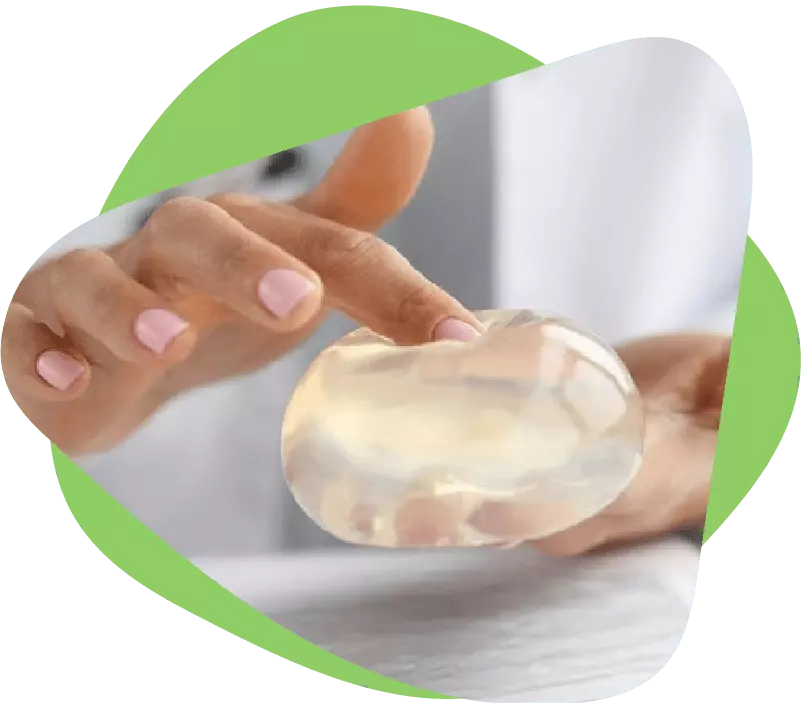
Breast reconstruction with an implant is often done in two stages.
The first stage involves placing a tissue expander in the chest where the breast was removed to help stretch the skin and create space for the implant.
In the second stage — several months later — an implant is placed where the expander was.
Tissue expanders are placed either under the chest muscle or over the chest muscle, under the skin. The location depends on how the muscle and skin have been affected by breast cancer treatment and surgery.
Breast implants consist of a silicone shell that’s either filled with saline (salt water) or silicone gel. Silicone gel implants may feel more like natural breast tissue than saline implants, which some people may find preferable.
One practical advantage of saline implants is that a rupture is usually easier to notice because the breast often changes size or shape. If a silicone gel implant ruptures, the change may not be obvious right away.
If a silicone gel implant ruptures, the gel may stay inside the scar tissue around the implant. Less often, it can move outside that scar tissue. This may cause symptoms such as pain, swelling, lumps, or changes in breast shape, and surgery may be needed to remove the implant and leaked gel.
Implant surgery can sometimes take place at the same time as a mastectomy. This is known as direct-to-implant breast reconstruction, and no tissue expanders are needed.
DIEP Flap Breast Reconstruction Deep inferior epigastric perforator (DIEP) flap reconstruction is a more complicated procedure than implant reconstruction.
With DIEP flap reconstruction, a flap of your own tissue — including skin, fat, and blood vessels — is taken from the lower abdomen (lower belly) and used to reconstruct the breast. DIEP flap surgery results in a breast that has its own blood supply, which helps the transferred tissue stay alive and healthy.
Other types of flap procedures use tissue from other parts of the body. These may include the thigh, back, or buttocks.
Flap procedures have some disadvantages and advantages. They require more complex surgery and can take six to eight weeks to heal. They require multiple incisions and lead to scarring in areas of the body where the flap is taken.
But flap surgery can look more natural than breast implants and has fewer long-term complications for some people. It can also result in a flatter abdomen in some people.
Goldilocks Mastectomy With a Goldilocks mastectomy, also known as a Goldilocks procedure, breast reconstruction occurs during mastectomy surgery. The Goldilocks procedure gets its name from the Goldilocks fairy tale because it aims to leave behind “just the right amount” of tissue to create a breast shape after mastectomy.
Cancer-free fatty breast tissue is used for the reconstruction. There’s no tissue taken from another part of the body.
This type of breast reconstruction may be appropriate for someone with a larger breast size where there’s enough healthy fatty tissue left after the cancerous tissue is removed.
A Goldilocks mastectomy is usually a less complicated surgery than other types of breast reconstruction. It may also involve a shorter recovery time.
There are pros and cons to a Goldilocks mastectomy. Although there may be fewer complications with this type of procedure, there’s a risk of fat necrosis (when fatty tissue is damaged and becomes firm scar tissue or an oil cyst). The breast shape can be unpredictable, and the reconstructed breast mound may flatten over time.
Recreating the Nipple Depending on your breast cancer diagnosis and the extent of your surgery, the nipple may be left in place during some mastectomies. This is known as a nipple-sparing mastectomy.
If the nipple can’t be preserved, a nipple can be reconstructed using skin from the reconstructed breast or, less commonly, tissue from another area of your body. Nipple reconstruction takes place after breast reconstruction has healed and the new breast is stable on the chest wall.
A 3D tattoo is an alternative to nipple reconstruction. It involves getting a specialized tattoo that creates the appearance of a raised nipple and areola. A reconstructed nipple can also be tattooed to look like a natural nipple.

Breast reconstruction surgery may require staying in the hospital for a few days. Doctors typically place a temporary drain — a small tube that carries fluid from the surgical area to a small container — near the surgical wound. This helps prevent fluid from building up as the body starts to recover from surgery.
You’ll be shown how to care for your surgical wound and empty the drain as fluid collects while you recover at home. You’ll also be given pain medication and recommendations for supportive clothing. Your doctor will remove the drain when the volume of fluid is low enough.
A few weeks after breast reconstruction, many people start to feel more like themselves as they begin to recover. Depending on the type of reconstruction you’ve had, you may need to limit your normal activities for about six to eight weeks or more.
It’s important to follow the advice of your surgical care team. Postoperative care (care after surgery) can help ensure that you heal well. Be sure to attend your follow-up exams.
Healing takes time, and you may not see final results right away.
On MyBCTeam, people share their experiences with breast cancer, get advice, and find support from others who understand.
Have you had breast reconstruction after a mastectomy? Let others know in the comments below.
Get updates directly to your inbox.





 Continue with Facebook
Continue with Email
Continue with Facebook
Continue with Email
Continue with Facebook
Continue with Email
Continue with Facebook
Continue with Email
Become a member to get even more





 Join
Join



 Your Privacy Choices

This is a member-feature!
Sign up for free to view article comments.
We'd love to hear from you! Please share your name and email to post and read comments.
You'll also get the latest articles directly to your inbox.