
Powered By


Can the tingling in.fingers be misinterpreted as carpal tunnel syndrome?
How can all these symptoms be both alleviated and fixed???
Thanks @A MyBCTeam Member. Another great topic. If I may add, those symptoms *can* be confused with stress-related tingling, and they can also overlap with carpal tunnel syndrome, but they are not the same thing. I have been experiencing paresthesia more so now than ever before.
How they can overlap
Paresthesia is the sensation of tingling, numbness, prickling, or “pins and needles.” Stress or anxiety can cause paresthesia through hyperventilation, muscle tension, and changes in blood flow. Carpal tunnel syndrome can also cause paresthesia, but it more often affects the thumb, index, middle, and part of the ring finger, and it tends to be worse with repeated hand use or at night. So yes, tingling in the fingers can be misread as carpal tunnel when stress is the real trigger, or vice versa.
How to ease symptoms
For stress-related paresthesia, slower breathing, relaxation, regular movement, sleep, and reducing caffeine can help. For possible carpal tunnel, wrist splints at night, neutral wrist posture, ergonomic changes, rest from repetitive hand use, and sometimes ice or anti-inflammatory medicine can help. If the tingling is from an actual nerve compression or another medical cause, treatment of the underlying problem is what fixes it long term.
What “fixing it” means
If it is mainly stress or anxiety, fixing it means lowering the trigger and calming the nervous system. If it is carpal tunnel, fixing it means reducing pressure on the median nerve, and in some cases that may require medical treatment or surgery. If it keeps happening, spreads, becomes one-sided, causes weakness, or comes with pain or loss of function, it should be evaluated by a clinician.
Hi @A MyBCTeam Member,
Thank you so much for your kind words!
Really and truly thank YOU, as I’ve been learning so much more from your posts. You consistently bring up topics that I never would have thought of on my own, which really inspires me to dig deeper and do more research I otherwise wouldn't have considered. Your perspective has been so valuable to me, and I truly appreciate you sharing your thoughts! 🕊️💜🙏
@A MyBCTeam Member
Thank
you so much for all this information.
I had not considered the other possibilities and will now have more information to work with on this.
💜💜💜💜
A simple first step is to notice the pattern: stress-related paresthesia often comes with worry or fast breathing, while carpal tunnel usually tracks with wrist position, typing, gripping, or nighttime symptoms.
*Radiation-induced brachial plexopathy* is a different and more specific concern than general paresthesia, stress tingling, or carpal tunnel. It affects the brachial plexus, the nerve network that runs from the neck into the shoulder, arm, and hand, and late symptoms can appear months or even years after radiation ends. (https://pmc.ncbi.nlm.nih.gov/articles/PMC12723156/)
Main difference
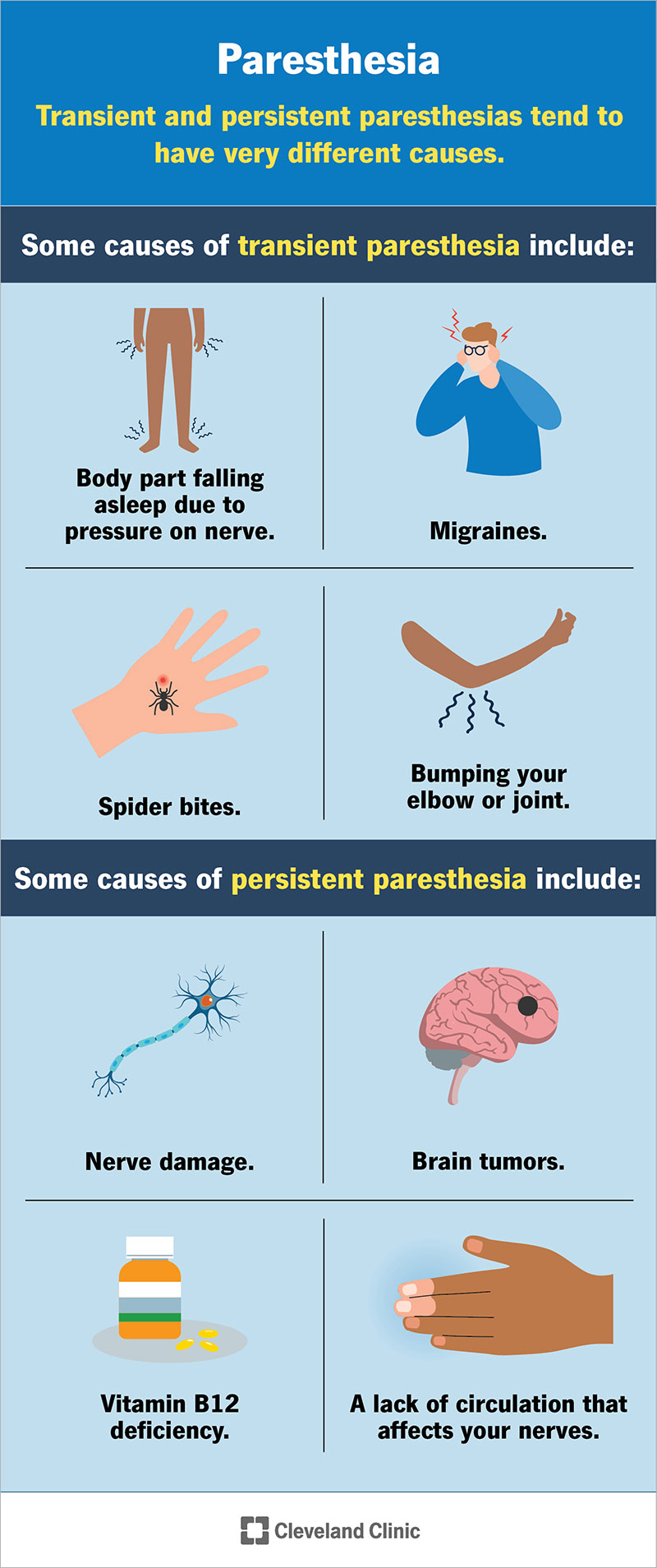
Paresthesia is the symptom: tingling, numbness, or pins-and-needles. (https://my.clevelandclinic.org/health/symptoms/...)
Stress-related tingling is paresthesia triggered by anxiety, hyperventilation, or muscle tension.
(https://brainandspinecenterllc.com/2024/06/12/d...)
Carpal tunnel is paresthesia caused by median nerve compression at the wrist.
(https://www.webmd.com/brain/tingling-in-hands-a...)
Radiation-induced brachial plexopathy is nerve injury from prior radiation, usually affecting the shoulder, upper arm, forearm, and hand on the treated side, and it may progress from tingling to weakness and loss of function. (https://now.aapmr.org/radiation-plexopathy/)
Why it matters
The pattern is often broader than carpal tunnel and less linked to stress. Late-onset radiation injury is described as insidious, with paresthesia and pain first, then weakness later. That history of prior radiation to the chest, neck, or axilla is a major clue. (https://www.advancedreconstruction.com/hand-upp...)
Important: This information is not a substitute for personal medical advice, diagnosis, or treatment; always talk to a qualified health professional about your own symptoms and concerns.




What to watch for
Get it checked promptly if tingling is on the same side as prior radiation and is accompanied by weakness, heaviness, reduced grip, pain, or worsening numbness. Those features are less consistent with simple stress tingling and more concerning for nerve injury. (https://journals.lww.com/neur/fulltext/2019/670...)
You usually tell by the pattern of the symptoms, not by the tingling alone. Stress-induced symptoms tend to come on with anxiety, fast breathing, or a stressful event and often improve when you calm down, while nerve problems like carpal tunnel, brachial plexopathy, or other neuropathies tend to follow a more specific location, trigger, and course.
Clues it is stress-related ...
It shows up during or right after stress, worry, or panic.
It may affect both hands or feel more generalized rather than one nerve path.
It often improves with slower breathing, relaxation, sleep, and less caffeine.
Clues it is a nerve problem ...
It follows a nerve pattern, like thumb/index/middle fingers for carpal tunnel, or shoulder/arm/hand on one side after radiation or brachial plexus injury.
It is persistent, worsening, or linked to weakness, loss of grip, pain, or muscle wasting.
It is not clearly tied to stress and does not reliably improve when the stress passes.
Important: This information is not a substitute for personal medical advice, diagnosis, or treatment; always talk to a qualified health professional about your own symptoms and concerns.


 Join
Join







 Your Privacy Choices