
Powered By



Recovering from a mastectomy takes time. Most people watch their incision closely, wondering what’s normal and what isn’t.
One change that can catch people off guard is a darkening or breakdown of the skin near the surgical site. This is known as mastectomy flap necrosis — a recognized complication your surgical team is fully trained to manage.
This article covers what mastectomy flap necrosis looks like, who may be at higher risk, how it’s treated, and what to expect from recovery.
When performing a mastectomy, surgeons leave a layer of skin behind to help cover the chest wall or support reconstruction. This is called a skin flap.
If blood vessels in the area become damaged or compressed, the blood supply is disrupted, leaving the tissue without the oxygen it needs to heal.
This lack of oxygen causes the death of the skin — a condition known as mastectomy flap necrosis. Studies suggest between 5 percent and 30 percent of people experience some degree of mastectomy flap necrosis after surgery.
The condition can range from minor, surface-level changes that heal on their own to deeper tissue loss that requires surgery. Understanding the difference helps set realistic expectations for recovery.
Partial-thickness necrosis affects only the outer skin layers. It may look like a darkened patch, a small blister, or a dry scab near the incision site.
Many mild cases can be managed with regular wound care and monitoring, without the need for additional surgical procedures. The skin in these cases often sheds the damaged tissue naturally over time.
Full-thickness necrosis extends through all layers of the skin. This type is more likely to require debridement or more complex repair.
One of the main concerns with this complication is that daily wound packing or waiting for a skin graft to take hold can delay radiation or chemotherapy by weeks or months.
Signs of mastectomy flap necrosis can appear anywhere from a few days to a few weeks after surgery.
A member of MyBCTeam said, “I am four weeks out from a double mastectomy and dealing with necrosis on both sides.”
On lighter skin tones, early discoloration often appears as pink or purple before turning darker. On deeper skin tones, changes may look like a subtle deepening or uneven darkening of the skin.
Signs of necrosis include:
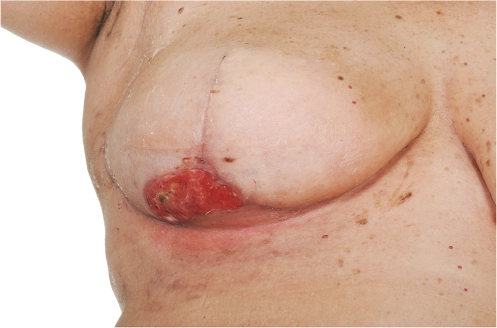
Necrosis may appear as raw, discolored skin near the incision site. In this case, the wound is bright pink with some scabbing. (CC BY-NC 3.0/Breast Cancer: Targets and Therapy)
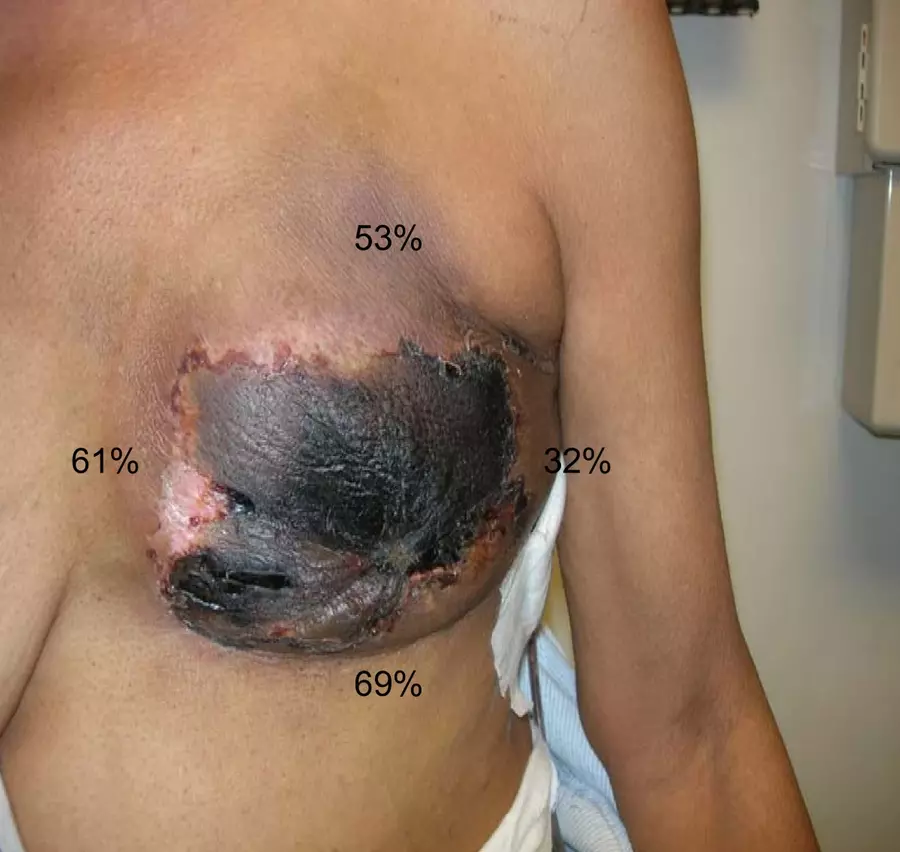
Necrosis can spread to cover a larger area if not treated promptly. (CC BY 2.0/World Journal of Surgical Oncology)
Several factors can raise the likelihood of developing skin necrosis. Some are tied to a person’s health before surgery, and others are tied to decisions made in the operating room.
 Conditions That Affect Circulation
 Conditions that reduce blood flow throughout the body or impair wound healing — such as peripheral artery disease or high blood pressure — can limit how much oxygen reaches the skin flap.
Smoking Smoking compounds the reduction of blood flow and oxygen, as nicotine tightens small blood vessels and slows healing. Research suggests that stopping smoking, even for a few weeks before surgery, may help reduce the risk of necrosis.
Diabetes or Obesity Diabetes can affect how blood vessels function, which may slow circulation to the skin flap. Extra body weight can have a similar effect, putting pressure on blood vessels and making it harder for blood to reach the outer skin layers.
Radiation Prior radiation to the chest is also worth discussing with your surgeon, as it can leave the small blood vessels in breast tissue less resilient over time.
The type of reconstruction — whether it uses a person’s own tissue or an implant — carries different risks, and necrosis rates can vary widely between methods. Implant or expander size also matters. An implant that’s too large can compress the surrounding skin, putting tension on the skin edges and restricting blood flow.
Skin Flap Thickness and Incision Type Skin flap thickness and incision design are additional variables your surgeon will weigh. Flaps that are too thin (less than 5 millimeters) may not receive adequate circulation. Certain incision types — particularly those encircling the areola — have been linked to higher necrosis rates in several studies.
How Is Mastectomy Flap Necrosis Treated? Treatment depends on how much tissue is affected and how deeply the necrosis extends. Mild cases are often managed without surgery, while more severe cases may require procedures to remove dead tissue and repair the wound.
Wound Care and Monitoring For small areas of necrosis, the primary approach is careful wound care and regular follow-up. Dressings — including alginate or silver-based preparations — are changed regularly as part of the healing process.
Debridement Debridement means removing dead or damaged tissue so that healthy tissue can heal underneath. Small areas can be debrided in a clinic setting. Larger or deeper areas may require a surgical procedure in the operating room, with the wound then closed or left to heal gradually.
Antibiotics Necrotic tissue can allow bacteria to grow, raising the risk of bacterial infection. If signs of infection develop — such as spreading redness or skin discoloration, increased warmth, bad smell, swelling, or fever — a doctor may prescribe antibiotics to prevent the infection from worsening.
Hyperbaric Oxygen Therapy Hyperbaric oxygen therapy involves breathing pure oxygen inside a pressurized chamber to deliver more oxygen to damaged tissue. Some individual case reports have described positive outcomes, but there is currently no strong clinical evidence to support its routine use to treat mastectomy flap necrosis.
Revision Surgery In severe cases, surgery may be needed to remove dead tissue, resuture the wound, or use a skin graft taken from another part of the body. If an implant has been exposed through the wound, removal may be necessary to prevent further complications like infection.
If surgery is needed to smooth out issues with breast reconstruction, it’s typically planned after the wound has fully healed.
Recovery from mastectomy flap necrosis varies depending on the severity. Mild cases may resolve within several weeks with consistent wound care, while more extensive cases can take much longer.
People who experience this complication often feel physical discomfort, treatment delays, and emotional stress that can affect quality of life. Support from a breast care nurse or mental health professional can help.
Most people are able to move toward their breast reconstruction goals, even if the path takes longer than expected.
Not every wound concern carries the same level of urgency. Some changes are worth a call during business hours, while others need immediate attention — day or night.
If you notice new dry scabbing or crusting around the incision, or skin that looks slightly darker or uneven compared to the last time you checked, those are worth flagging at your next available appointment.
Mild drainage — fluid that isn’t growing in volume or developing an odor — and discomfort that isn’t improving but also isn’t getting rapidly worse both fall into this category. None of these changes signals an emergency, but your care team will want to know about them.
Some changes shouldn’t wait. Spreading redness, darkening, warmth, swelling, or a new fever may be signs of a bacterial infection and should be checked right away.
Call your care team right away if you notice any of these signs:
Mastectomy flap necrosis is a recognized complication of breast cancer reconstruction surgery that can range from minor skin changes to more involved wound care and surgery. With the right support, most people are able to work through it.
Before your next appointment, try a few small steps. Write down any changes you’ve noticed at the incision site, and take pictures if possible. Review your discharge instructions for wound care reminders.
Ask your surgeon which warning signs to watch for at home. If something doesn’t look or feel right, don’t wait — contact your surgical team.
Healing rarely follows a straight line, and setbacks along the way don’t define the final outcome. Many people who experience wound complications after mastectomy go on to complete their reconstruction.
A member of MyBCTeam said, “Although I had surgery today for necrosis on an area that’s not healing from my bilateral mastectomy, it’s still a good day! Hopefully, this is it! I am feeling good despite some tugging and pulling discomfort.”
On MyBCTeam, people share their experiences with breast cancer, get advice, and find support from others who understand.
What piece of advice would you give to someone just starting their mastectomy recovery? Let others know in the comments below.
Get updates directly to your inbox.




 Continue with Facebook
Continue with Email
Continue with Facebook
Continue with Email
Continue with Facebook
Continue with Email
Continue with Facebook
Continue with Email
Become a member to get even more





 Join
Join




 Your Privacy Choices

This is a member-feature!
Sign up for free to view article comments.
I had a bilateral mastectomy and had expanders during surgery. I went to the Dr every 2 weeks for saline injections to stretch the skin (I was extremely small, prior). I didn’t want large breast just… read more
We'd love to hear from you! Please share your name and email to post and read comments.
You'll also get the latest articles directly to your inbox.